Walk-Forward Validation and Out-of-Sample Testing for LLM Sentiment Factors
Practical feature engineering with LLMs in quantitative trading: structured event extraction, temporal alignment, exponential decay, and Walk-forward out-of-sample incremental testing.
When integrating Large Language Models (LLMs) into quantitative research, prompting the model directly for buy/sell trading decisions frequently leads to black-box decision paths, blurred temporal boundaries, and strategy instability caused by minor prompt variations. Crucially, this end-to-end approach conflates semantic text understanding with portfolio risk optimization, obstructing factor attribution and risk control.
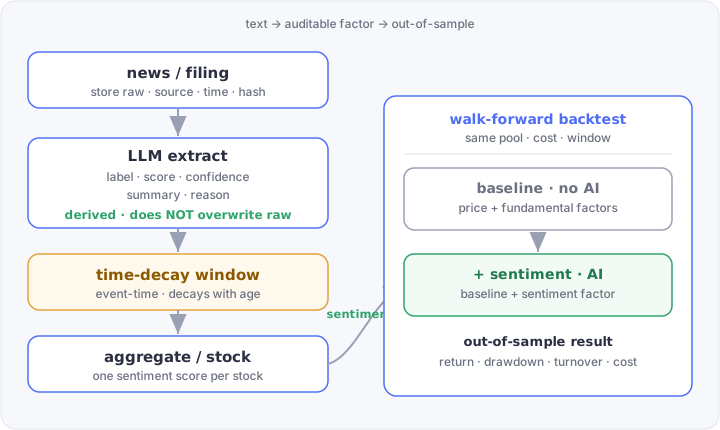
In robust quantitative engineering, LLMs are best positioned within the feature engineering pipeline as structured information extractors: transforming unstructured news and financial disclosures into quantifiable, auditable events. Downstream portfolio construction and risk management are handled by deterministic multi-factor models, with real alpha validated through rigorous out-of-sample experiments.
Structured Text Extraction and Audit Design
When raw news articles or regulatory filings enter the system, source URLs, publication timestamps, and raw text content hashes (SHA-1) are persisted immediately. The language model processes the text to emit standardized structured attributes:
- Sentiment Label:
bullish,neutral, orbearish; - Sentiment Score: Normalized to the range
[-1.0, 1.0]; - Confidence Level: Bounded in
[0.0, 1.0]; - Executive Summary & Rationale (
reason): Extracts core facts supporting the sentiment judgment; - Model Metadata: Records model version identifiers and inference timestamps.
The structured event schema is defined as follows:
{
  "event_id": "sha1(raw_text)",
  "published_at": "2026-03-11T09:20:00Z",
  "source_url": "https://...",
  "label": "bullish",
  "score": 0.62,
  "confidence": 0.71,
  "summary": "raised quarterly revenue guidance",
  "reason": "filing projects next-quarter shipment volume to increase 20% QoQ",
  "model": "llm-vX",
  "analyzed_at": "2026-03-11T09:24:10Z"
}
The system strictly adheres to the principle: “raw data is immutable; derived features are recomputable.” Raw text is preserved as immutable ground truth. Sentiment scores and reasoning points are stored as derived features. When prompt templates are refined or models are updated, extraction can be re-executed across historical corpora to generate new feature versions for comparative backtesting.
Temporal Alignment, Event Deduplication, and Exponential Decay
Maintaining temporal consistency is paramount to preventing look-ahead bias in sentiment factor engineering:
- Strict Timestamp Alignment: The point at which an event enters factor calculation must align with public media dissemination (
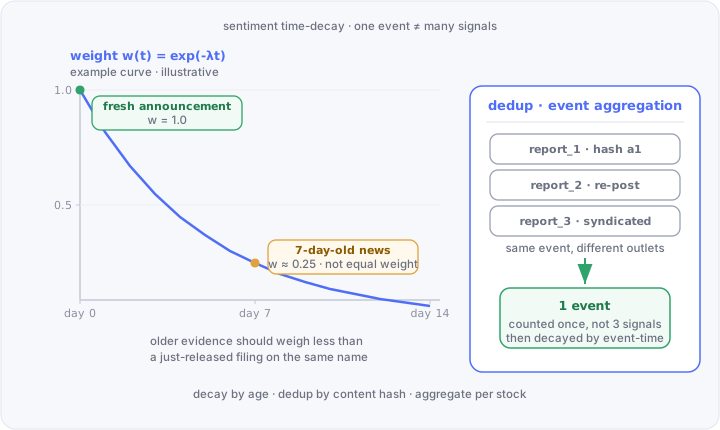
published_at), which must strictly precede the strategy’s rebalancing decision timestamp; - Multi-Source Deduplication: Major news items are frequently syndicated across multiple outlets. The system clusters identical content via hashes, preventing syndicated coverage from being counted multiple times and fabricating artificial “consensus strength”;
- Exponential Time Decay: The market impact of news decays over time. The system applies an exponential decay weighting window to aggregate historical events per ticker:
w(t) = exp(-λ · Δt)          # Δt = Decision timestamp − Event publication timestamp (in days)
Score_stock = Σ_i  w(t_i) · Confidence_i · Score_i
Controlled Experiments and Incremental Alpha Evaluation
High classification accuracy does not guarantee trading profitability. If sentiment signals are already priced in, or if the resulting turnover cost exceeds the gross alpha, the factor provides zero net value.
The platform establishes a controlled experiment framework: holding universe, transaction cost assumptions, and backtest windows constant, it compares a baseline strategy (price-volume and fundamental factors only) against a strategy incorporating the sentiment factor:
| Evaluation Dimension | Baseline (No LLM Sentiment) | Augmented Strategy | Core Question |
|---|---|---|---|
| Out-of-Sample Annualized Return | Reference | Test Group | Does the factor generate positive net alpha? |
| Max Drawdown & Volatility | Reference | Test Group | Is return gained by excessively amplifying risk? |
| Turnover Rate & Friction Cost | Reference | Test Group | Does gross alpha cover execution slippage and fees? |
| Regime-Specific Performance | Reference | Test Group | Is alpha consistent across trending and oscillating regimes? |
| Inference Latency & API Cost | — | Measured Metric | Is the compute cost viable for production rebalancing? |
Walk-Forward Analysis and Out-of-Sample Integrity
To avoid overfitting and data snooping inherent in static in-sample backtests, the system enforces Walk-Forward cross-validation:
- The historical timeline is divided into rolling, overlapping training and testing segments;
- Factor weights, decay parameters, and thresholds are optimized exclusively on the In-Sample (IS) training window;
- Parameters are locked and executed exactly once on the immediately following Out-of-Sample (OOS) test window;
- The composite strategy equity curve is generated by concatenating consecutive OOS performance segments.
Window 1: [--- Training 1 ---][ Test 1 ]
Window 2:        [--- Training 2 ---][ Test 2 ]
Window 3:               [--- Training 3 ---][ Test 3 ]
Composite OOS Equity:                  [ Test 1 ][ Test 2 ][ Test 3 ]
Throughout the Walk-forward workflow, test segments remain strictly blinded to optimization routines. When a test window underperforms, the system logs the result as an indicator of regime sensitivity, strictly forbidding retroactive hyperparameter tuning on evaluated data.
Engineering Boundaries and Summary
In quantitative research platforms, LLMs provide the highest utility in transforming massive unstructured corpora into standardized, auditable feature sets. Portfolio allocation and execution discipline remain governed by deterministic quantitative models, with true factor viability proven through out-of-sample testing and comprehensive friction accounting.
This factor engineering pipeline and Walk-forward framework are fully integrated into the AI Quant System research suite.
This article is for technical research and quantitative methodology discussion only and does not constitute investment advice.