Rigorous Audit Rules for Quantitative Backtesting
A systematic guide to backtesting integrity: causality enforcement (shift(1)), point-in-time financial data, cost sensitivity stress testing, Walk-forward isolation, and sample-level look-ahead prevention.
In quantitative strategy research, overfitting an equity curve with an exceptional Sharpe ratio is relatively easy, but such strategies almost inevitably fail in live production. In most cases, live underperformance is not caused by abrupt market regime shifts, but by hidden look-ahead bias, data leakage, and improper statistical practices embedded in backtest routines.
To ensure that backtest metrics carry statistical validity and practical execution guidance, this article details essential audit rules for quantitative research pipelines.
Temporal Causality in Signal Generation
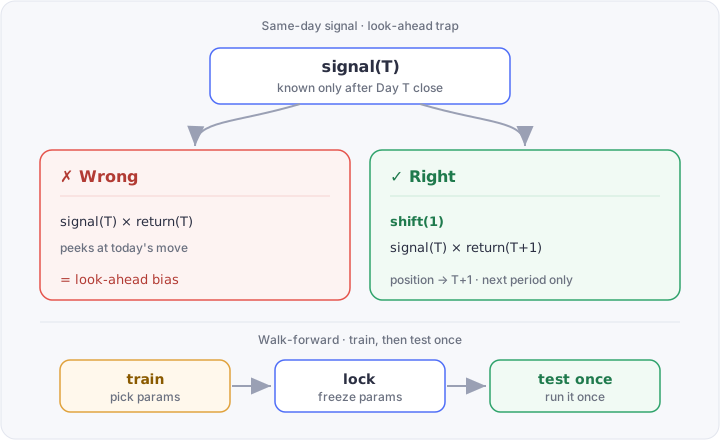
The most pervasive and insidious form of look-ahead bias occurs when signal generation and trade execution timestamps are improperly aligned.
If a strategy computes indicators using day $T$'s closing prices, orders can only be executed at the earliest during the $T+1$ market open or intraday session. Multiplying day $T$'s signal directly by day $T$'s price return implies prior knowledge of that day’s price movement. This logical flaw generates no runtime exceptions, but fictitiously inflates returns and smooths drawdowns.
In production codebases, temporal causality must be enforced via explicit lags (e.g., shift(1) in pandas) and guarded by unit tests:
# Unit test validating that signals only affect subsequent periods
import pandas as pd

price = pd.Series([10.0, 10.0, 11.0, 12.0, 13.0])      # Price jump occurs at index 2 (Day 3)
raw_signal = (price > price.shift(1)).astype(int)       # Signal generated after close
position = raw_signal.shift(1).fillna(0)                # Shift by one period to enforce causality
pct_returns = price.pct_change().fillna(0)
strategy_returns = position * pct_returns

# Assert: price jump at index 2 must only generate returns from index 3 onward
assert strategy_returns.iloc[2] == 0.0
assert strategy_returns.iloc[3] > 0.0
Point-in-Time (PIT) Consistency for Financial Fundamentals
Corporate financial statements have a reporting period (report_period, e.g., December 31) that precedes public disclosure (available_at, typically March-April of the following year) by months. Querying fundamental data based solely on report_period introduces severe look-ahead bias, using unannounced financial figures in early-year rebalancing.
To eliminate look-ahead leakage in corporate fundamentals, datasets must support Point-in-Time (PIT) constraints:
report_period: The accounting fiscal period;available_at: The exact timestamp when the filing became publicly accessible on exchange feeds;revision_type: Distinguishes between preliminary earnings guidance, flash reports, audited annual filings, and subsequent restatements.
On each rebalancing date $t$, query pipelines must enforce available_at <= t and retrieve only the latest disclosure publicly available at that exact moment. When handling accounting restatements, retroactive corrections must not overwrite historic flash disclosures previously known to the market.
Execution Friction and Cost Sensitivity Stress Testing
Gross returns without realistic execution frictions are detached from live trading reality. Stamp duties, exchange fees, broker commissions, bid-ask spread slippage, and market impact costs erode profitability—especially in high-turnover models.
After establishing a baseline backtest, researchers must run cost sensitivity stress tests:
- Baseline Friction Model: Standard commission, statutory stamp taxes, and baseline slippage (in bps);
- Double Friction Stress Test: Double the slippage and fee assumptions to evaluate drawdown expansion and alpha decay;
- Turnover Reduction Test: Increase holding thresholds to verify whether alpha remains resilient as turnover drops.
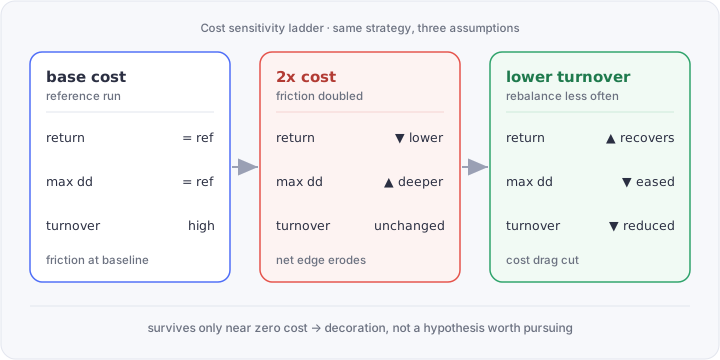
If a strategy’s returns collapse under minor cost increases, the model is simply exploiting low-friction simulation artifacts rather than capturing genuine economic alpha.
Out-of-Sample Isolation and Preventing Data Snooping
Researchers often succumb to data snooping by iteratively tweaking parameters after observing poor performance in a specific test window. Even when individual modifications appear sound, this practice converts test data into an implicit training set, invalidating statistical conclusions.
Adopting Walk-Forward analysis enforces rigorous parameter isolation:
- Parameter optimization is strictly confined to rolling In-Sample (IS) training windows;
- Locked parameters are evaluated exactly once on the immediately following Out-of-Sample (OOS) window;
- Strategy performance is evaluated strictly on the concatenated sequence of OOS returns.
Sample-Level Look-Ahead Bias Prevention
Beyond time-series alignment, asset universe definitions must be protected against survivorship and classification biases:
- Survivorship Bias: Using a universe composed only of actively trading stocks retroactively excludes historical bankruptcies, delistings, and distressed companies. Backtest universes must dynamically reconstruct historical constituent rosters (including delisted tickers);
- Trading Halts & Limit Price Liquidity: Strategies signaling buy orders during trading halts or limit-up lockups cannot execute in live markets. Backtest engines must simulate realistic matching barriers and reject unexecutable orders;
- Historic Sector and Index Classification: Historical sector classifications and index constituent weights must reflect point-in-time definitions rather than current standards.
Quantitative Audit Checklist
When reviewing strategy backtest reports, evaluate against this audit checklist:
- Does order execution adhere to strict $T+1$ causality relative to signal generation?
- Are fundamental and macroeconomic indicators constrained by Point-in-Time timestamps?
- Is the dynamic universe free of survivorship bias, including historic delistings?
- Does the matching engine reject orders during trading halts and limit-up/limit-down conditions?
- Has the strategy passed double-friction and slippage sensitivity stress tests?
- Are parameters optimized solely on training windows and validated via Walk-Forward OOS testing?
- Does the report disclose turnover rates, sub-period breakdowns, and maximum drawdown durations?
Embedding these audit standards into the AI Quant System ensures research integrity and protects against false alpha.
This article is for quantitative research and technical methodology discussion only and does not constitute investment advice.