Orchestrating Agent Workflows with State Graphs in the Smart Cockpit
Starting from why a single prompt struggles with multi-step business logic, this article walks through Graph-based state models, tool loops, multi-specialist collaboration, and how customer-service workflows connect to Coding Agents and cybernetics.
When giving technical talks or discussing LLM applications, it is easy to start by listing popular frameworks and terms: Spring AI, LangGraph, RAG, MCP. After hearing all the names, people often still have a practical question: “Calling an LLM API for chat already works smoothly—why go to the trouble of building workflow orchestration?”
I went through the same stage when I started building Agents, until I tried handling a real business request:
“Check order SO20261001 for me and see how much can still be refunded.”
On the surface, it looks like an ordinary natural-language question. Once you write the business logic, however, a single prompt quickly hits a wall:
The moment the model receives that sentence, it cannot know how many days ago the order was delivered, what item was purchased, or its current fulfillment state. Even if you write a long prompt that gets the model to list “Step 1: check order, Step 2: calculate refund,” planning in prose is not execution in a real system. The program has to pause, query the order service with the extracted order ID, put the returned fact (“delivered 3 days ago, unopened”) back into context, and only then let the model calculate the refund amount under the return policy.
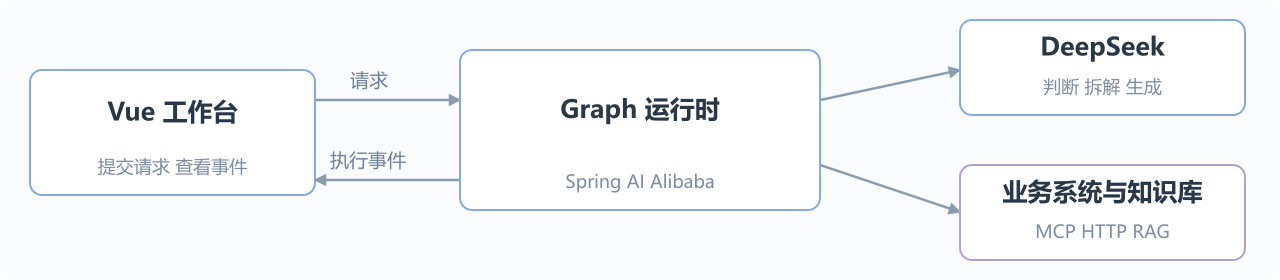
This agentDemo prototype—originally built for an internal technical talk with Vue 3, Spring AI Alibaba Graph, and DeepSeek—was later merged into the Enterprise Smart Cockpit (enterprise-ai-cockpit repository). Below, using architecture diagrams, flowcharts, and code from the project, I walk through why business-grade Agents rely on workflow orchestration and how we built it step by step.
From Single API Calls to Goal-Driven Stateful Systems
In the basic LLM usage pattern, the flow is straightforward: combine a System Prompt with the user question, call Chat Completion once, and render the returned Markdown. For weekly reports, copy editing, or summarizing a self-contained document, a single request works well.
That simplicity can create the impression that tuning a detailed prompt is enough to build an Agent. In real business systems, however, single-shot calls run into three structural bottlenecks:
- Dynamic dependencies across steps: as in the refund scenario, step two’s input depends on step one’s actual API response. Without a real Observation from step one, downstream reasoning is guesswork.
- Strict deterministic business rules: policy answers must align with the vector knowledge base; report analysis must pull numbers through controlled MCP endpoints; refund trials must follow dedicated pricing logic; heated disputes must hand off to human staff. Stuffing entire manuals, database schemas, and tool definitions into one huge prompt strains the context window and dilutes attention.
- Environmental variance and fault recovery: downstream APIs time out, initial vector retrieval can miss key chunks, and models occasionally emit malformed JSON. A single call has no way to preserve progress and retry cleanly when a local hiccup occurs.
An Agent is therefore neither a clever prompt nor a bare model API, but a stateful engineering system that advances tasks toward a goal. Architecturally, reasoning and runtime execution need clear separation:
- Brain (LLM / Reasoner): handles unstructured semantic understanding, intent extraction, and proposing the next action from known facts (Policy Inference);
- Body and Runtime Container (Host Runtime & State Container): manages cross-step state persistence, safe tool execution, permission checks, step budgets, and human handoff recovery.
| Dimension | Single Prompt + API | State-Graph Orchestration |
|---|---|---|
| Context supply | Assembled statically up front; prone to overload or omission | Injected dynamically step by step from prior tool results |
| External execution | Generates parameter text only; cannot execute calls itself | Host validates arguments, runs network calls, and catches errors |
| Branching logic | Relies on model prose to cover possible branches | Routes deterministically via Conditional Edges in the state machine |
| Fault recovery | Any error aborts the entire request | Wraps errors as Observations for retry, fallback, or human handoff |
| Termination rule | Ends whenever the model emits EOS | Determined jointly by acceptance checks, evidence, and step budgets |
Underlying Computation Model of State Graphs and Stack Choice
Why Linear Pipelines Fall Short
When starting out with Agent orchestration, the most intuitive pattern is a sequential pipeline (A -> B -> C).
Linear chains feel clean for fixed pipelines, but become awkward once loops and feedback revisions appear: rewriting a query when retrieval comes up short, or re-planning with error context after a tool call fails, forces either deep recursion or external while loops full of ad-hoc state variables.
A State Graph addresses branching and cyclic control flow directly through four core elements:
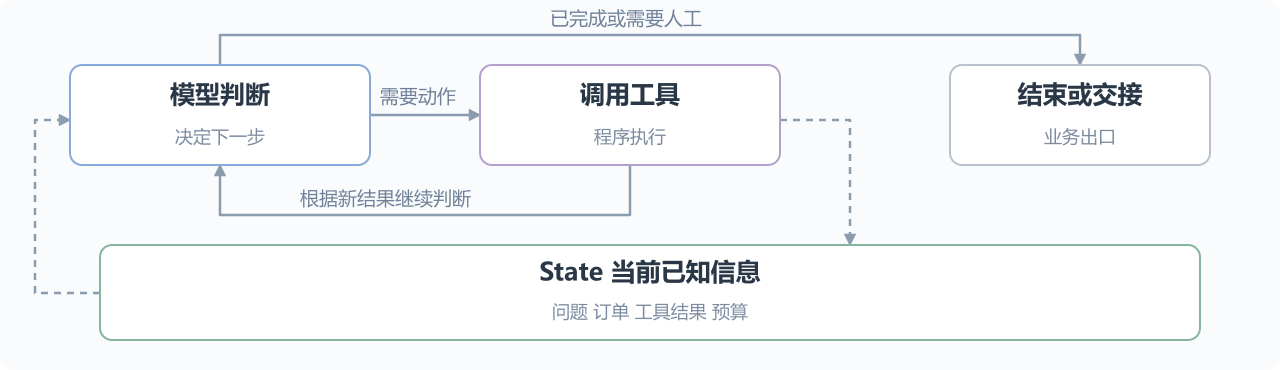
- State (Blackboard): the shared memory container across the graph’s lifecycle, tracking the user query, intent and confidence, retrieved chunks, tool requests and responses (
Observations), iteration counts, and answer drafts, governed by explicit merge strategies. - Node: an atomic unit of work following a functional style—reading slices of
State, performing a single task (calling a model, querying vectors, invoking an API, or formatting data), and returning aState Deltawithout holding private cross-request state. - Edge and Conditional Edge: regular edges represent fixed transitions, while conditional edges evaluate state fields to route dynamically—sending policy questions to retrieval, orders to tools, and low-confidence inputs to human handoff.
- Cycles and Budgets: edges can point back to upstream nodes to express ReAct (“decide — act — observe — decide”) loops, paired with both graph
recursionLimitand business round budgets that route to human fallback when exhausted.
Choosing Spring AI Alibaba Graph in a Java Stack
In Python, LangGraph brought graph computation and finite-state-machine ideas into Agent runtimes early on. While Python is great for quick prototypes, Java remains the primary backend stack for many enterprise microservices.
Maintaining a separate Python service solely for an Agent module adds deployment, concurrency, and database-integration overhead. Because the Smart Cockpit backend already runs on Java and Spring Boot, we built directly on Spring AI Alibaba Graph for strong typing, dependency injection, and native Spring integration.
Designing the Smart Cockpit Customer-Service Workflow
In an enterprise customer-service scenario, real user requests vary widely:
- Consultation A: “What is the return policy for Aero headphones? Can I return them unused three days after delivery?” (Policy Q&A requiring vector retrieval and clause citation);
- Consultation B: Uploading a red-blinking LED screenshot and asking “What does this mean and how do I fix it?” (Multimodal vision extracting fault code E02 before troubleshooting retrieval);
- Consultation C: “Check order SO20261001 and calculate the refundable amount based on its status.” (Sequential, state-dependent tool calls);
- Consultation D: “Query the September 2026 sales report and tell me revenue and order volume.” (Enterprise integration discovering and calling internal report services over MCP);
- Consultation E: “Explain the headphone return policy, the refundable amount for SO20261001, and the September sales report.” (Cross-domain composite request requiring task decomposition and multi-specialist coordination);
- Consultation F: “I completely disagree with this compensation amount—someone needs to resolve this!” (Dispute or low-confidence intent requiring full context preservation and smooth human handoff).
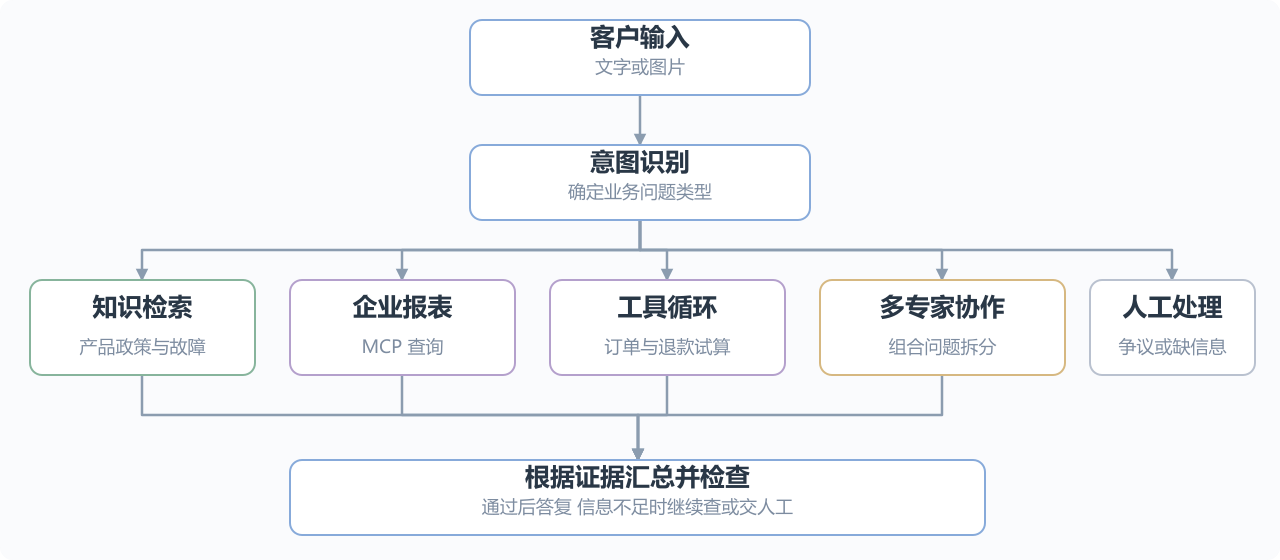
To support these paths, we designed an end-to-end state-graph topology:
Runtime state changes and trace events stream from the backend Graph runtime to the frontend workbench:
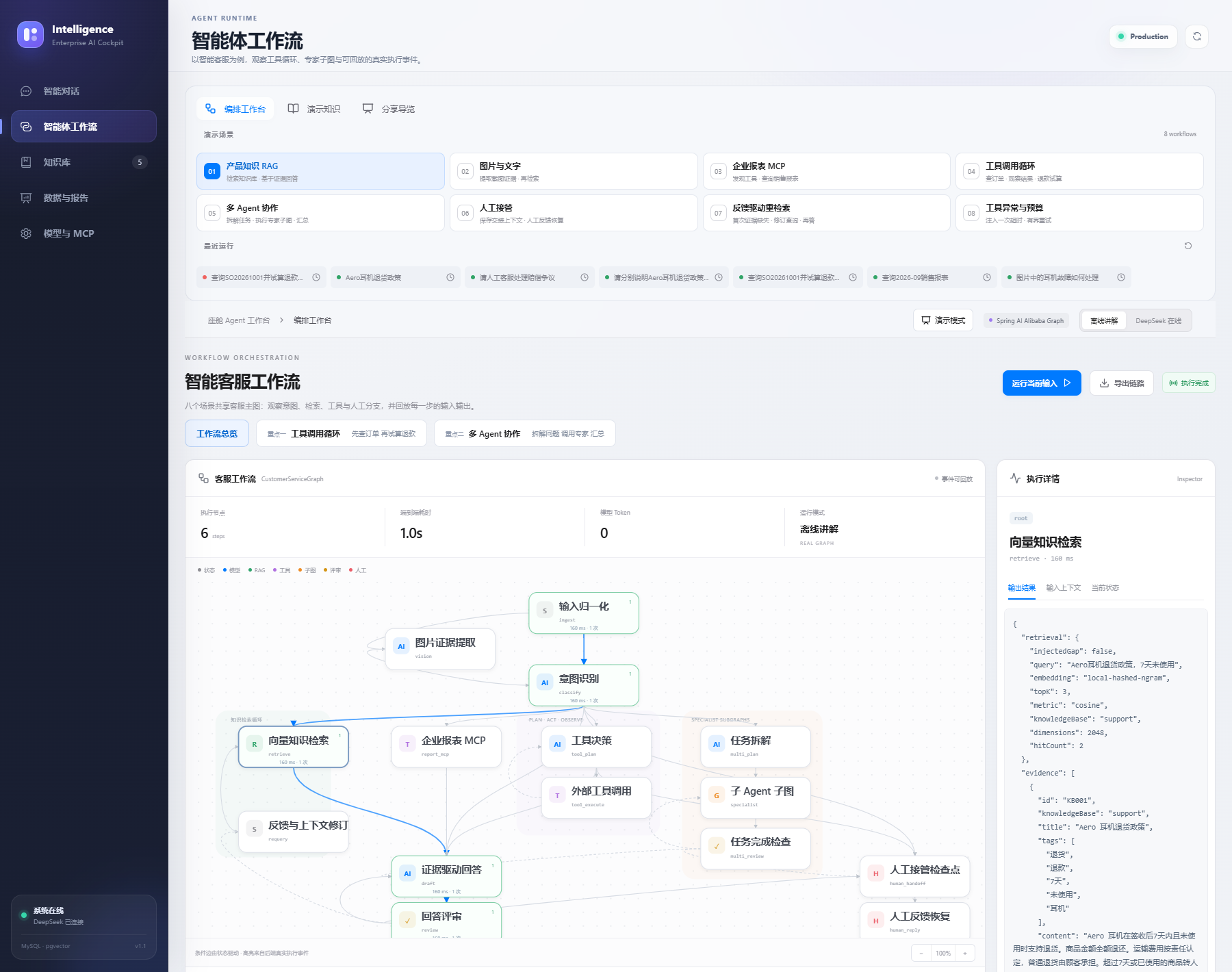
Inside the cockpit, the workbench provides eight scenario entries, run history, main-graph visualization, and live node inspection:
Execution proceeds through five clear stages:
- Input normalization and vision: if an image is attached, a lightweight vision model extracts visible text and fault codes into normalized state;
- Intent classification and routing: outputs the target branch (
rag/report/tool/multi/human) and confidence, routing below 0.6 directly to human handoff; - Domain branch execution: runs RAG retrieval, MCP report lookup, native Tool loops, or multi-Agent collaboration;
- Draft and Review: synthesizes a draft from collected evidence and checks citation consistency, triggering rewrite or query re-retrieval if needed;
- Human-in-the-Loop: snapshots context and suspends execution at the handoff node until staff input resumes the flow.
At the code level, the main graph uses ReplaceStrategy to update state fields deterministically, merging existing lists with new tool results before returning deltas. We also separate Tool Calling (the model-layer convention for declaring function names and arguments) from MCP (the application-layer standard using tools/list and tools/call to discover and invoke external services), wrapping the standalone report MCP server as a state-machine-governed tool.
Implementing the Two Core Mechanisms
Tool-Call Loop (Tool Loop / ReAct Loop)
For “check order SO20261001 and calculate the refundable amount,” the model cannot know item price or delivery status on round one; the host must fetch the order facts and write them into state before round two can run refund calculation.
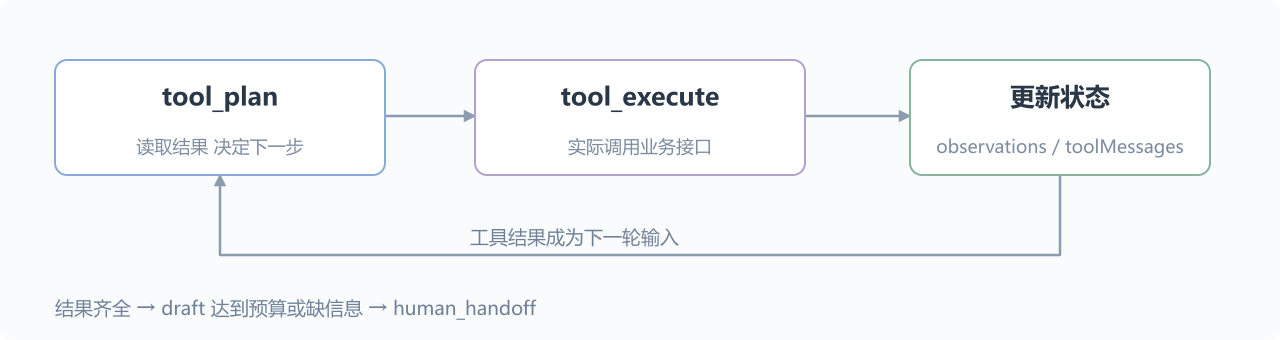
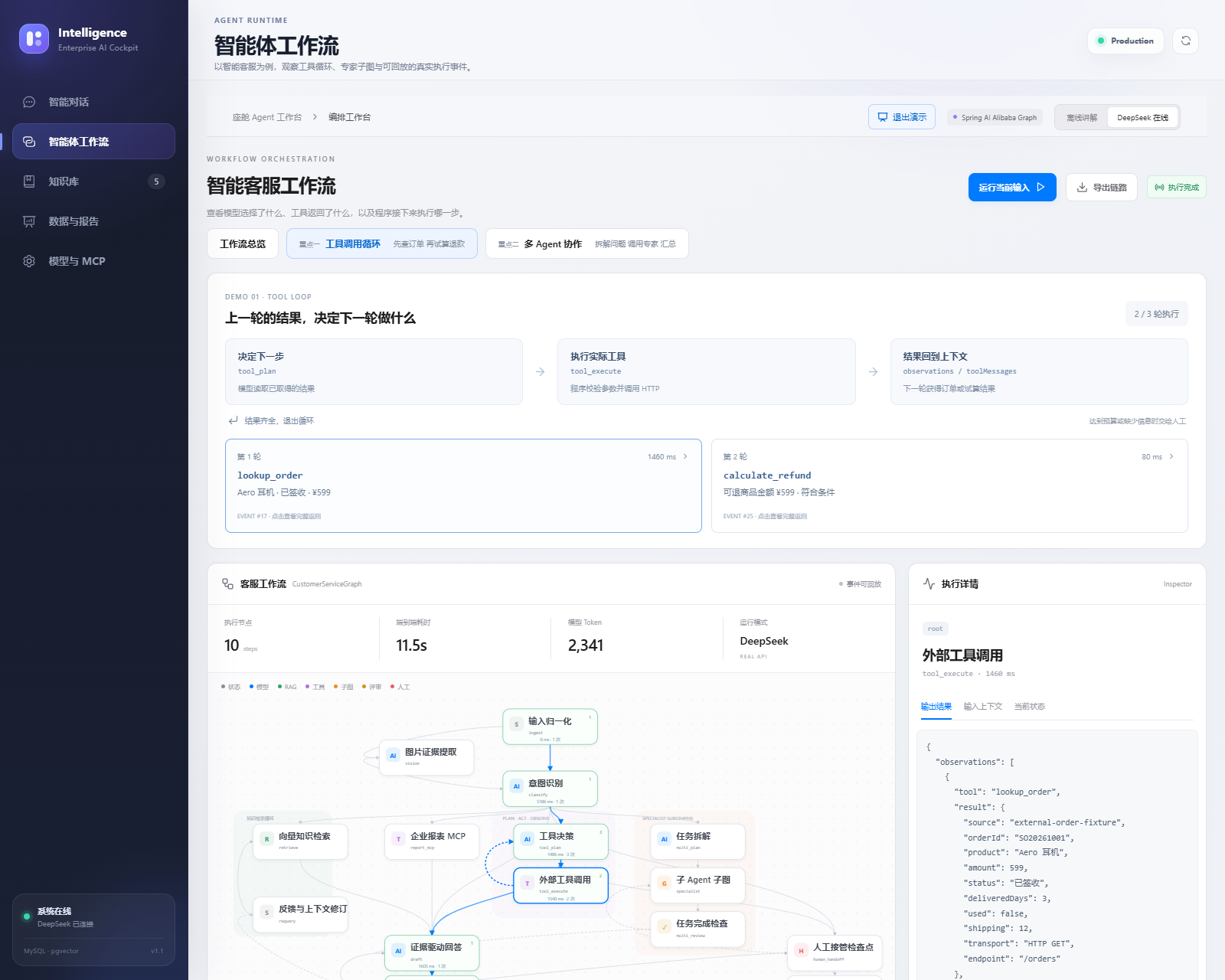
In the Graph, we split the loop into tool_plan (decision) and tool_execute (execution):
graph.addNode("tool_plan", this::toolPlanNode);
graph.addNode("tool_execute", this::toolExecuteNode);

graph.addConditionalEdges(
    "tool_plan",
    edge_async(state -> (String) state.data().get("toolNext")),
    Map.of(
        "execute", "tool_execute",
        "done",    "draft",
        "human",   "human_handoff"
    )
);

graph.addEdge("tool_execute", "tool_plan");

CompiledGraph app = graph.compile(
    CompileConfig.builder().recursionLimit(80).build()
);
Map<String, Object> toolPlanNode(State state) {
    if (state.hasObservation("calculate_refund")) {
        return Map.of("toolNext", "done");
    }
    if (state.getInt("toolRound", 0) >= state.getInt("maxIterations", 3)) {
        return Map.of("toolNext", "human", "handoffReason", "Tool budget exceeded");
    }
    List<ToolDefinition> allowedTools = resolveAllowedTools(state);
    ToolCall call = modelGateway.planNextTool(state.getMessages(), allowedTools);
    return Map.of("pendingTool", call, "toolNext", "execute");
}

Map<String, Object> toolExecuteNode(State state) {
    ToolCall call = (ToolCall) state.get("pendingTool");
    ToolResult result = enterpriseTools.execute(call.name(), call.arguments());
    return Map.of(
        "observations", state.appendObservation(result),
        "toolMessages", state.appendToolMessage(call.id(), result.toText()),
        "toolRound", state.getInt("toolRound", 0) + 1
    );
}
The essential distinction here is that model tool_calls are proposals, whereas actual HTTP responses are Observations. Round one runs lookup_order (“delivered three days ago, unused, 599 yuan”); round two unlocks calculate_refund and obtains the 599-yuan refundable result, while timeouts or budget limits route cleanly to retry or human fallback.
Multi-Agent Collaboration (Specialist Sub-graphs)
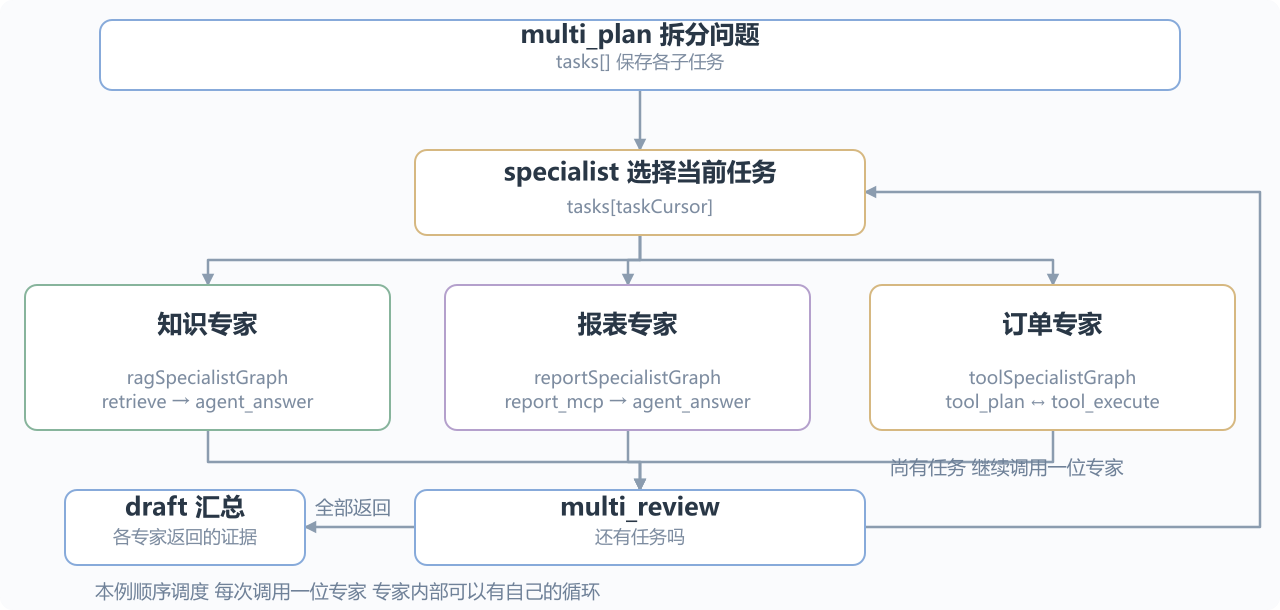
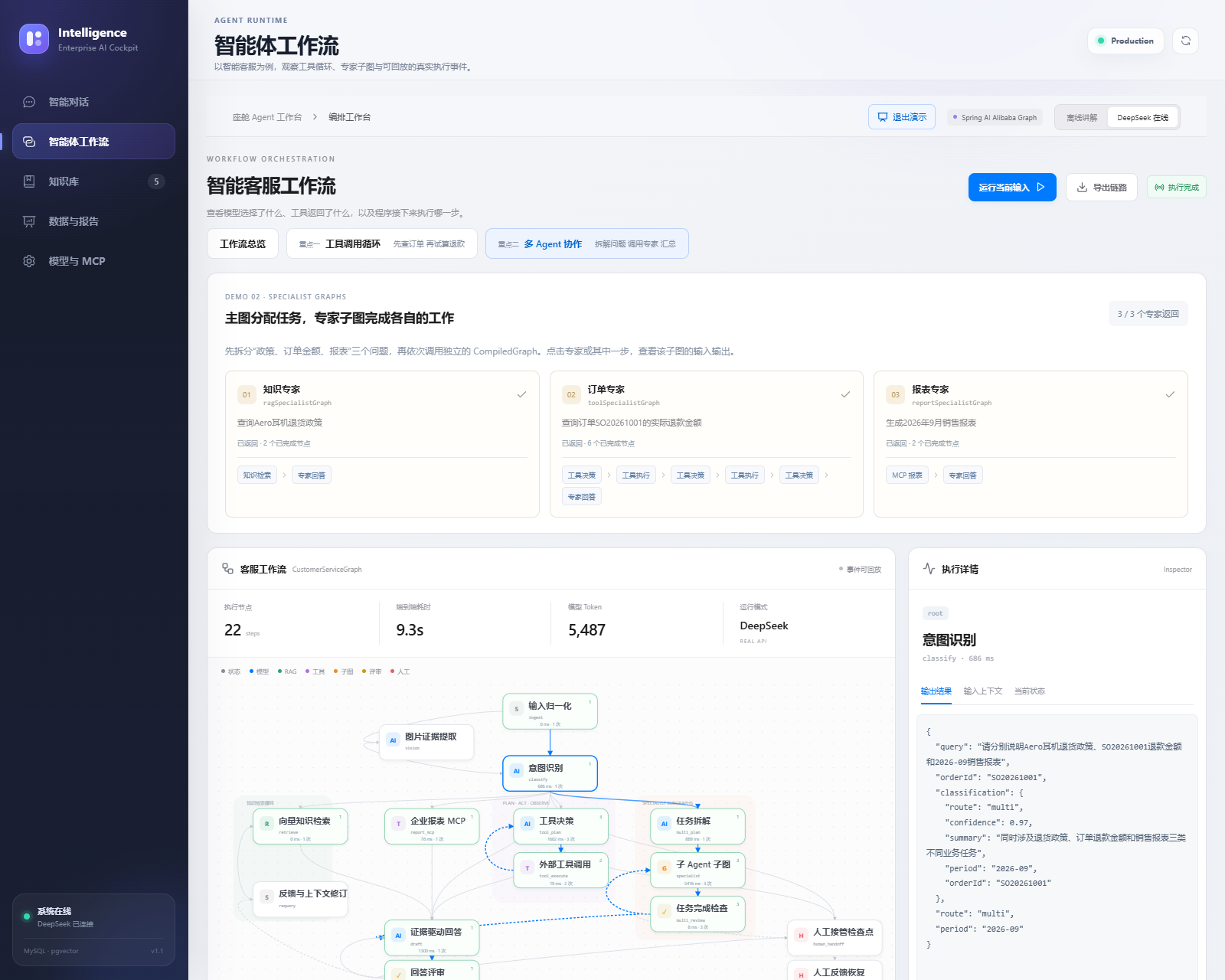
When a user asks about return policy, order refund, and September sales in a single prompt, stuffing knowledge search, order APIs, and report schemas into one context invites tool confusion. Instead, a coordinator dispatches independent specialist subgraphs:
graph.addNode("multi_plan", this::decomposeTasksNode);
graph.addNode("specialist", this::invokeSpecialistSubGraphNode);
graph.addNode("multi_review", this::reviewProgressNode);

graph.addEdge("multi_plan", "specialist");
graph.addEdge("specialist", "multi_review");

graph.addConditionalEdges(
    "multi_review",
    edge_async(state -> (String) state.data().get("multiNext")),
    Map.of(
        "next",  "specialist",
        "done",  "draft",
        "human", "human_handoff"
    )
);
- Task decomposition (
multi_plan): splits composite requests intotasks = [Task(RAG), Task(Tool), Task(Report)]; - Specialist execution (
specialist): invokes independently compiled subgraphs with isolatedThread IDstate while inheriting the mainTrace IDand parent Span ID; - Progress review and synthesis (
multi_review->draft): advances the task cursor sequentially and synthesizes a unified answer once all specialists finish.
Extending from Customer Service to Coding Agents and Cybernetics
Zooming out to widely used Coding Agents (such as Claude Code, Cursor, OpenAI Codex, and SWE-agent), their ability to navigate repositories, edit files, and fix bugs shares the exact same underlying control architecture.
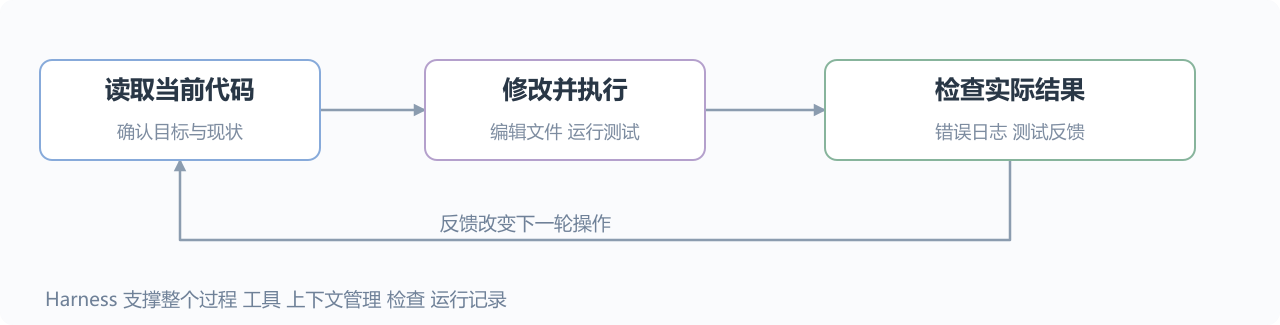
Capable Coding Agents never rely on a single prompt generating an entire system in one shot; they operate through tight feedback loops:
- Parse requirements and align goals (Goal Setting);
- Search the codebase and locate symbols (Grep / AST tools);
- Formulate an edit plan (Plan);
- Apply targeted file edits (Action);
- Run compilers, linters, or unit tests (Observe);
- Inspect diagnostics or stack traces: exit if green, or feed errors back into state to plan the next fix (Self-Correction Loop).
This is why teams at Anthropic and OpenAI emphasize Harness Engineering—“Prompt is cheap, foundation model is commodity, harness is the differentiator.”
What is a Harness? It is the surrounding sandbox, toolchain, context trimming, progress assertions, and evaluation framework wrapping the model. If the model is the brain, the Harness is the engineering rig that turns intelligence into dependable productivity.
From a systems perspective, this reflects Norbert Wiener’s Cybernetics in modern software engineering: for any autonomous system to achieve a goal reliably in an uncertain environment, it must rely on negative feedback—measuring the error between current state and target state, and feeding that error back into the controller to guide the next action until the gap closes and the system converges.
A single prompt call is an open-loop system whose output quality depends heavily on luck; a state-graph-orchestrated Agent is a closed-loop system governed by feedback. That is the core architectural value workflow orchestration brings to AI applications.
You can try all eight scenarios interactively on the Smart Cockpit workflow page; the next article covers the underlying node monitoring and timeline replay implementation.